
Calm Is Expensive
What it actually takes to build a life that feels easy to operate

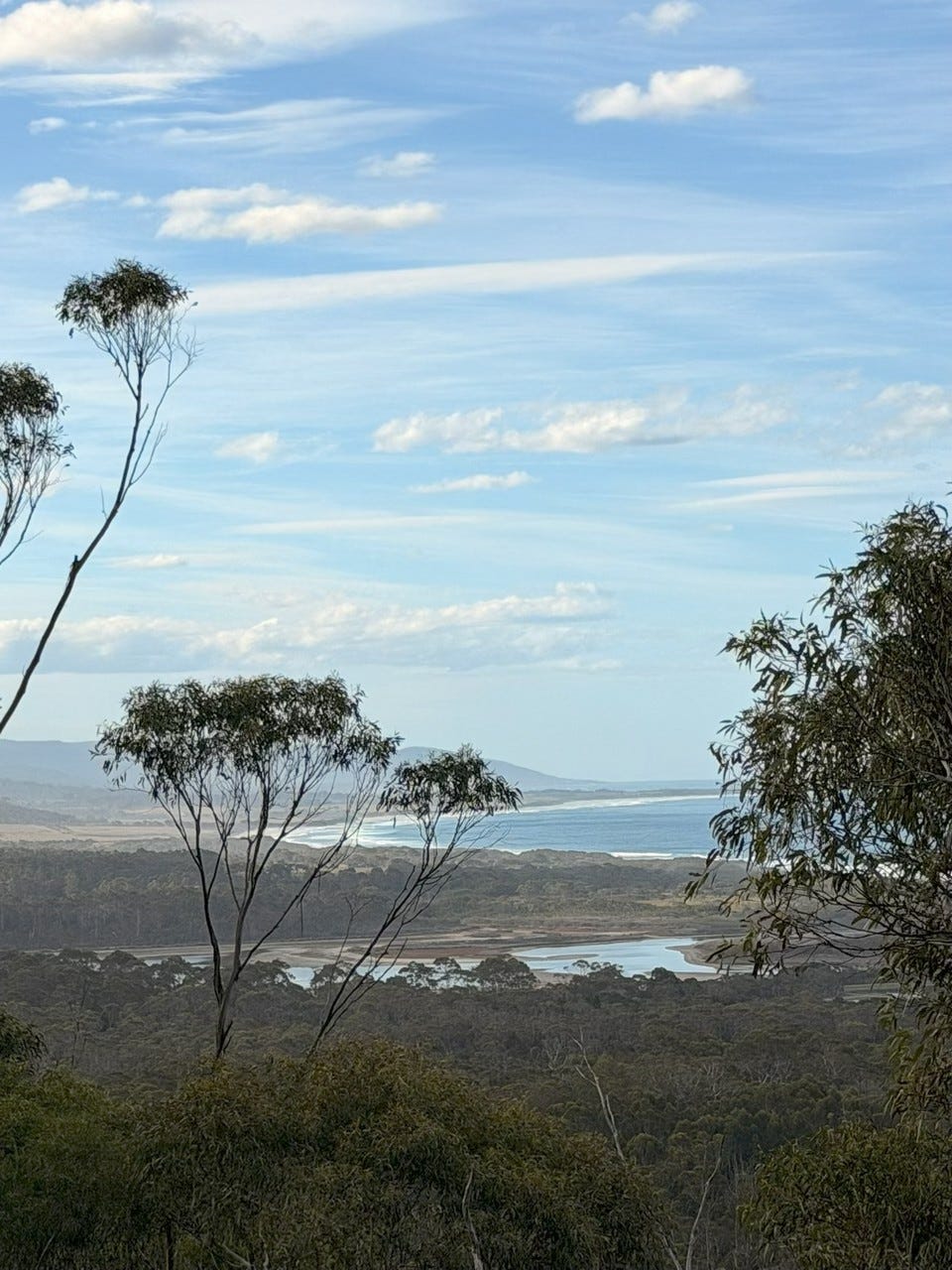
We stayed outside the park on purpose.
That’s not how most people do Freycinet. You stay in Coles Bay, where everything is closer. Easier. More efficient.
But we’d set up our slow travel month in Tasmania a little differently. We base ourselves in one place, then take shorter offshoot trips—just a few days at a time—to explore what’s around it. Bicheno was one of those.
On paper, it didn’t make sense. More driving. More coordination. More time just getting to where we were supposed to be optimizing.
But by that point, we weren’t optimizing for proximity anymore.
We were paying attention to something else.
The first time we went into Freycinet, we did what most people do. We followed the plan—hit the lookout, walked the track, tried to fit in the pieces that felt like they mattered. It worked. We saw everything we were supposed to see.
But it felt like we were moving through it, not inside it.
The second time, we did less. We left later, skipped a stop, turned around earlier than planned. Nothing about it was more efficient. But the day opened up. We noticed more. We weren’t trying to get through it.
And somehow, it felt easier.
That’s when it started to become clearer.
Not in a big way. Just enough to notice the second day required less from us to feel good.
The Shift Most People Miss
Most people misread what’s happening in moments like this. They think they need a better plan—something more efficient, more optimized.
But what they actually need is a life that requires less from them to operate.
The weight doesn’t come from the visible parts. It comes from everything you have to manage to make those parts work.
Most days don’t feel heavy because something is broken. They feel heavy because of the constant, low-level effort required to keep everything running—more decisions, more coordination, more adjustments.
Nothing dramatic. Just enough to make everything harder to operate.
And when that load stacks, you don’t feel it all at once. You feel it in how quickly your capacity disappears.
What We Actually Changed
Bicheno wasn’t closer. It wasn’t more convenient. But it required less from us. We didn’t have to plan the day as tightly or coordinate every movement. We didn’t have to think as much just to get to the starting point.
That’s the part most people never design for.
You don’t notice how much your life requires from you until it stops.
A Quick Way to See It
A quick way to check is to look at what in your life currently requires ongoing effort just to keep working. Not the big things—the small, repeated adjustments.
That’s where your capacity is going.
Because calm isn’t about doing nothing. It’s about removing what you have to keep compensating for.
What Calm Actually Costs
Calm isn’t accidental. It’s built.
It often means choosing something that doesn’t look optimal—something slightly farther, slightly slower, slightly less efficient on paper—but removes layers of invisible effort over time. You don’t always see that tradeoff when you make the decision. You feel it later, in how the day moves, in how much thinking it requires, in how much of yourself it takes just to keep things working.
You can’t manage your way into calm.
💛 Kelly
Before you try to make your life calmer this week, do this instead.
Look at one day—not what’s on it, but what it requires from you to keep it working. Where are you holding things together? What are you tracking in the background? What would happen if you didn’t?
Then remove one thing.
One decision. One obligation. One layer of coordination.
Then notice what changes.
Because calm doesn’t come from doing things better.
It comes from needing to hold less.
Paid subscribers get the decision framework we use before we choose where to go, what to take on, and how to structure a season—so we don’t rebuild the same life with a different view.
Because calm isn’t something you stumble into.
It’s something you choose, long before you arrive.
If you want to see how we actually apply this, I put together a simple version of the decision filter we use:
Open the Free Decision Compass.
It’s the starting point.
But it won’t stop you from rebuilding the same life on its own.
Series Note
This is part of a series on capacity—how it builds, how it erodes, and how to design a life that doesn’t require constant effort to operate.
The last piece showed what change costs when something breaks.
This one shows what you’re buying when you pay for calm.
Next, I’ll share the decision framework we use to choose differently—so we don’t recreate the same pressure in a new place.
Brilliant.
Calm is what’s left when less is competing for your attention.
I just realized comments were turned off on this post 🙃
Reopening it because I’m genuinely curious—
Most people don’t notice this until something breaks. But the signal shows up earlier—in the small things that keep requiring adjustment.
What’s one thing in your life right now that only works because you keep managing it?