
You Don’t Need Clarity. You Need Something Steady.
What Perth taught me about making decisions when certainty isn’t available

Most advice assumes change arrives with clarity.
A signal.
A moment.
A feeling that tells you what to do next.
Perth didn’t offer that.
It worked on us quietly — through light, water, movement, and systems that made it easier to exhale than to perform.
Nothing announced itself. Nothing demanded certainty. The steadiness came first.
If you’re in a season where decisions feel heavier than usual — where you’re acting on partial information, managing a nervous body, or trying not to burn everything down just to feel relief — this is what Perth gave me instead of answers.
We arrived after thirty-seven hours of travel time.
Long flights. Layovers. Time zones stacked on top of each other. By the time we landed, Nigel and I were both fighting colds — that low-grade, foggy feeling that never quite knocks you out but never quite leaves you alone either.
Add jet lag to the mix, and we never fully felt our best.
And still, the place worked on us.
Life felt organized here. Not rigid. Not controlling. Just held.
Rules mattered. Two hands on the steering wheel wasn’t a suggestion; it was just normal. Safety and collective responsibility were built into daily behavior in a way that felt steady rather than strict.
I’ve noticed this kind of thinking elsewhere, too. In Perth, every concert ticket includes a train ticket — a quiet assumption that access, movement, and shared responsibility belong together.
Not as a moral stance.
Just as design.
Care showed up in quieter ways as well.
When we arrived, our hosts — Tim and Michele — already had plans for the evening.
“Make yourself at home,” Michele said. “There are lots of great veggies in the fridge.”
And there were.
Beautiful, fresh food. Nothing precious. Nothing performative. Meals built around what was alive and local. Eating outside. Lingering. Parks everywhere — not ornamental ones, but usable ones. Spaces designed for bodies to move, sit, gather, rest.
It wasn’t framed as wellness.
It was simply how life was organized.
There was generosity too — visible, measurable, civic. Telethon raised A$97 million for children’s hospital care and medical research in Western Australia alone. A significant portion of the lottery supports charities. Pride showed up in tangible ways, not slogans.
And still, the contradictions were real.
Rents were high. Housing was tight. People fell through the cracks. The story wasn’t one-sided. It was layered.
That mattered to me.
Because real steadiness isn’t fragile.
It holds complexity.
One night in Perth, we had dinner with someone whose financial resources were, by any measure, significant.
What stayed with me wasn’t the money — it was how little it seemed to resolve. The conversation circled caution, timing, responsibility. Fewer constraints, yes. But not fewer questions.
It clarified something I’ve been circling for years: money expands options, but it doesn’t remove uncertainty. Calm doesn’t come from wealth alone. It comes from alignment — with place, pace, and the life you’re actually living.
Sitting there, it became obvious that Perth’s quiet confidence wasn’t about who had the most.
It was about how little people needed to prove.
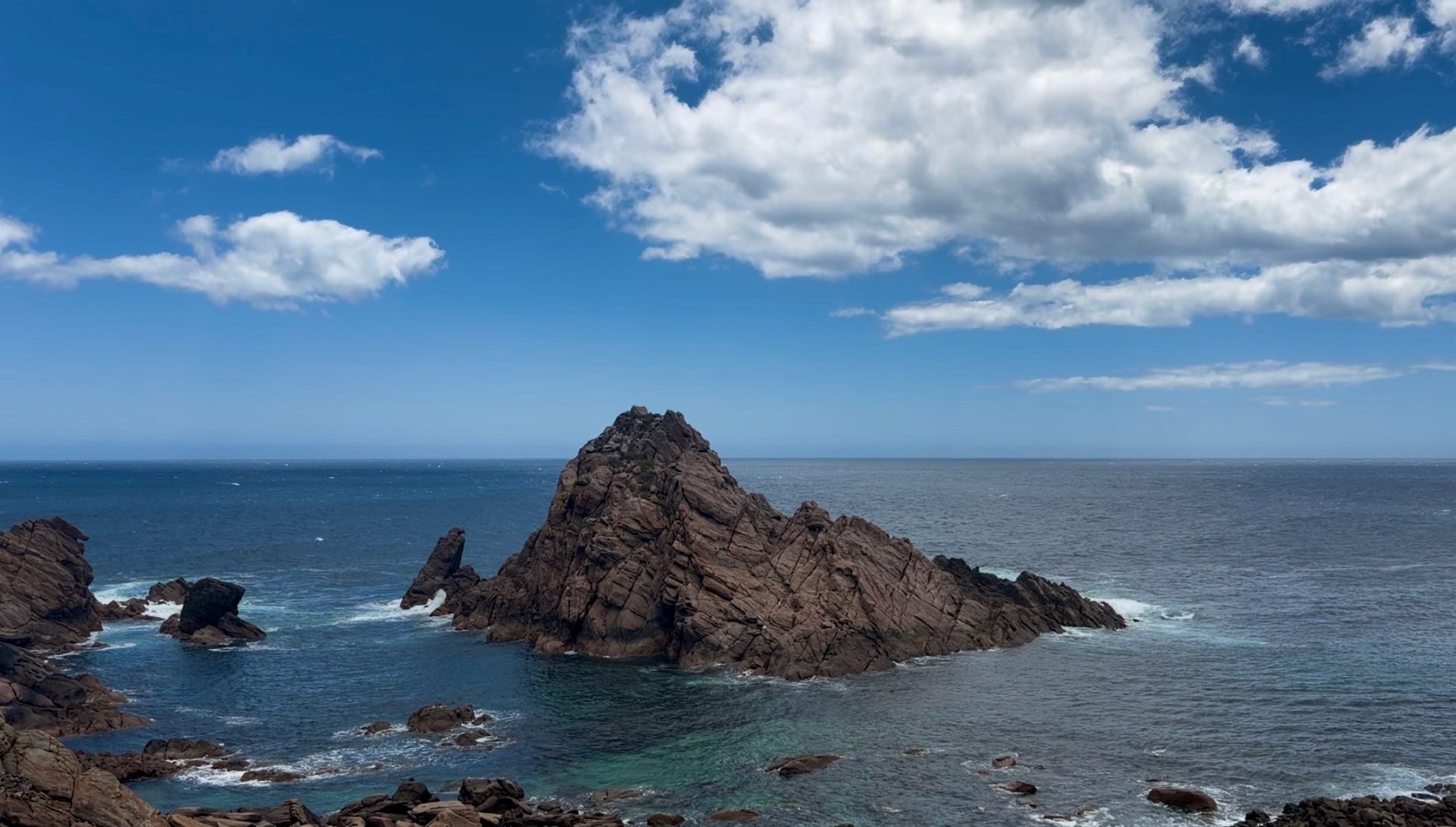
South of the city, the coastline stretched longer than my attention span. Sugarloaf Rock. Wide beaches. Nothing fenced in or curated for effect.
Just space.
Enough of it that my nervous system stopped scanning for edges.
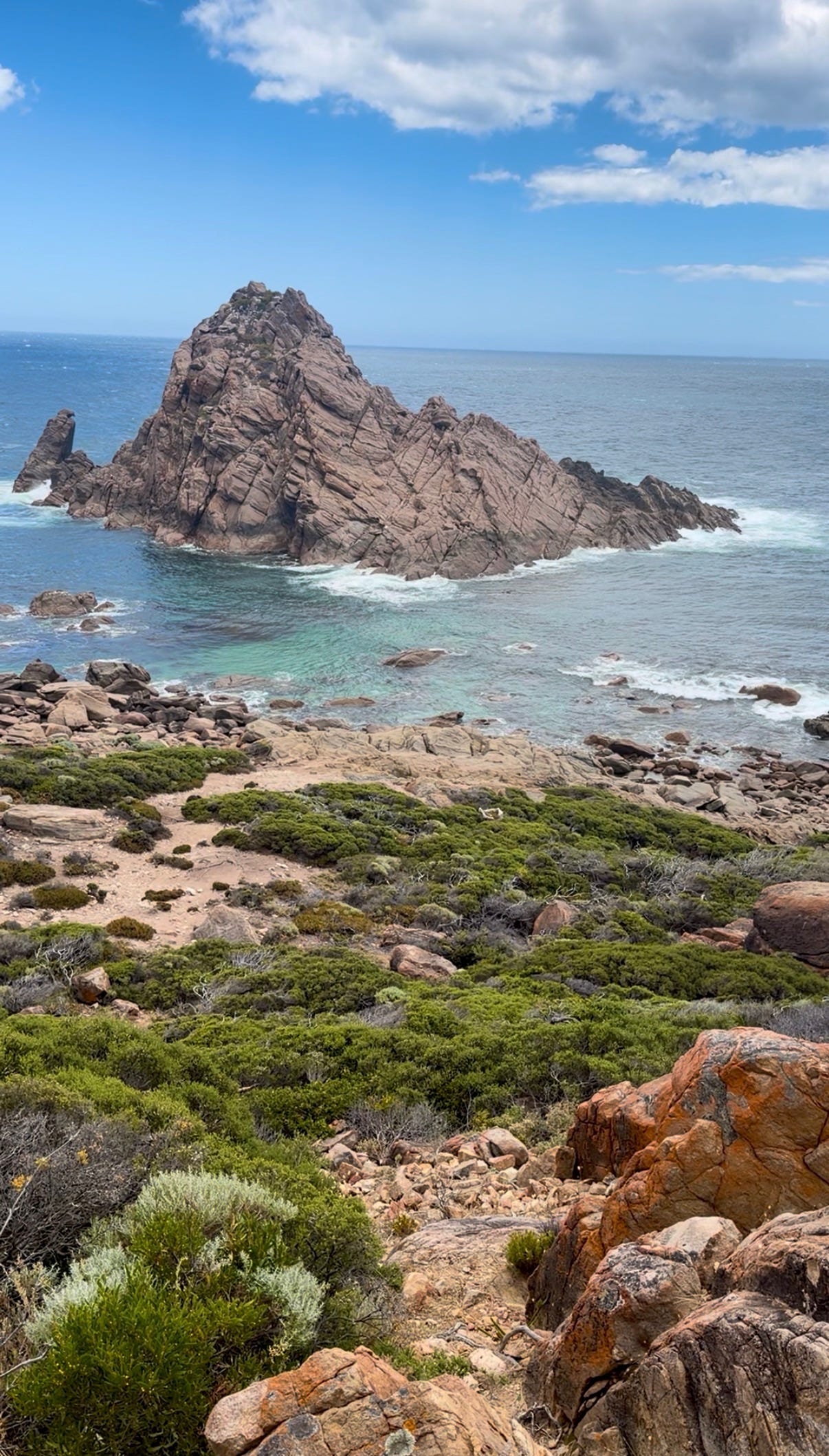
Nature here doesn’t erase tension.
It holds it.
On Rottnest Island, moments of elemental quiet — sea, lighthouse, horizon — coexist with human noise and cheer. The quiet place is never empty. It’s alive.
Even the quokkas reflect that kind of resilience. Able to go months without water. Built for dry stretches. Quietly adapted.
Rottnest offered a smaller, more personal lesson too.
I was nervous before we even boarded the ferry. Seasickness. Wind. Heat. Crowds. All the things my body loves to protest.
The winds were calm from the east on the way over, which helped. But once we arrived, the island was busy — loud, cheerful, full.
So we walked in the opposite direction.
Toward the lighthouse.
Away from the noise.
And sat for a while.
Somewhere between the ferry ride and that quiet patch of ground, my body caught up. The nerves eased. The motion settled. I realized — again — that sometimes I have to move through discomfort to reach steadiness.
That’s a hard truth for me.
I’m a delicate flower on my best days.
Later, we took the bus around the island. Air-conditioning. Relative quiet. Just the guide’s voice and the hum of movement.
By then, I felt okay. Comfortable, even.
On the way back, I barely made it.
Which felt like the point.
Relief isn’t a permanent state.
Comfort doesn’t arrive all at once.
And ease doesn’t mean avoiding the hard parts — it means knowing you can survive them.
What ultimately grounded us in Perth, though, wasn’t policy or landscape.
It was people.
Tim and Michele were the reason we came in the first place. Nigel’s dad had served in the Gurkhas alongside Tim’s decades ago. They hadn’t seen each other since the 1980s — but the familiarity was still there.
That generosity — unshowy, human, connective — settled us into this leg of the journey in a way nothing else could.
That may be the constant across places.
Systems differ.
Rules differ.
Landscapes change.
But people — kind, generous, open — are what shape how a place lands. And how we do.
Lately, I’ve been thinking a lot about how we make decisions when certainty isn’t available. When the information is partial. When the body is tired or off. When the future doesn’t offer guarantees.
If that’s you right now, Perth didn’t give me answers either.
It gave me something steadier.
A reminder that safety isn’t the absence of risk.
That calm doesn’t have to come first.
That belonging isn’t about perfection — it’s about enough support to exhale.
Sometimes you don’t need a dramatic leap.
You need a place — or a system, or a person — that lets you regulate long enough to hear yourself think.
Micro-shift for the week ahead:
Notice where you’re bracing unnecessarily. Ask yourself what would help you feel held — not inspired, not transformed — just steady enough to stay.
The map doesn’t always come before the movement.
Sometimes steadiness shows up quietly — and changes you anyway.

💛 Kelly
If you’re navigating a season of change — travel or otherwise — and want thoughtful essays about belonging, decision-making, and building steadiness without drama, you’re welcome here.
I write most Sundays about how places shape us — and how we shape our lives in return.
Subscribe if you’d like these reflections in your inbox.
Want to support the work?
You can buy me a flat white here ☕
(It helps fund the writing — and the very long flights.)
Thinking about long-term travel or moving abroad?
I’ve also built practical planning tools — frameworks, checklists, and decision guides — for people who want to do this thoughtfully, not impulsively.
Deep one today Kelly. Thank you. This part hit me most, "money expands options, but it doesn’t remove uncertainty." Sometimes I wish we had more money, but deep inside I know that won't make us more confident or capable or self-reliant. Or happy. And those are the crucial characteristics our lifestyle needs right now.
So I will continue to be a frugal sailor, but one who can do anything. 🌎💙
And thank you for including the cute little quokka. He really made me smile!
This resonates deeply! I'm currently building a location-independent business while slow traveling through Southeast Asia, and the "you don't need clarity, you need something steady" message is exactly what I needed to hear. The way Perth worked on you quietly through systems and rhythms rather than dramatic moments - that's so real. I've found the same thing moving between cities: sometimes a place just helps you regulate without demanding anything from you. The part about surviving Rottnest Island despite the discomfort really hit home. I'm a delicate flower traveler too, and learning that "ease doesn't mean avoiding the hard parts" has been crucial. Your writing captures that nuanced reality of long-term travel - it's not always Instagram-perfect, but the steadiness matters more than the highlight reel.